|
|
 |
 |

|
|
|
|
 making of |
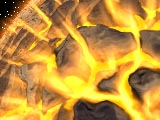
An entire planet with uncountable pieces, each different-looking, fitting togehter like a puzzle and never overlapping. The gas jets break out exactly between them. So how did I do this? It is a kind of simulated iso-surface. Several centered spheres are layered with the same semi-transparent texture. As the spheres get smaller, the texture is slightly moved, too. In this image, there are 40 spheres for the surface and 50 spheres for the gas jets textured with Pov's crackle pattern. At a higher resolution, you really can see those layered spheres at the horizon. With higher resolution, there has to be a higher count of spheres (where the horizon will be the critical part of the picture) and a higher max_trace_level value. This will increase rendering time a lot. The Tie-Interceptor is that one I found at "Star Wars: The POV-Ray Collection" created by Dylan M Beattie in 1997 (see related links below) and I just gave it a new texture - not quite the original, but looking good.
|
|
source code |
First, the max_trace_level ist set at a higher value. Otherwise you can't look through all the spheres. This is the value how far rays are traced after reflections or through transparency. There are two loops creating two sets of textured spheres. The a_field will be the solid planet, the b_field will be the gas jets. The first (outer) sphere gets a crackle-like texure map. The gaps get transparent (t_trans) and the 'plates' get stone-like (t_solid). The other spheres (scaled by 0.0005 each) get the same crackle, but only colored texture. There is a gradient from transparent black at 0.1 to solid dark brown at 0.2. this helps to smear and round the edges of the plates and causes a little structure into depth. The jets are made of the same (inverted) crackle texture. With the radius of those spheres getting bigger, the texture is getting more red and transparent. The source to the right can be used as a complete scene file. To use it as an include, remove the last block and call the object 'brk_planet' from within your own scene file. The planet will appear at the origin with a surface radius of 1 unit.
|
|
future works |
Perhaps waterfalls, endless woods covering large landscapes, asteroid fields etc. can be done too. You can use and modify the planet above in your own scenes as you like, but you should mention my name and homepage. And I would be pleased to get an url where I can admire your work, either the planet or some other particle texture using my technique.
|
|
related links |
 Star Wars: The POV-Ray Collection |
|
|
|